
Calhoun County Arrest History
A Calhoun County arrest creates related records under separate custodians. The arresting officer makes an arrest or incident report. Orangeburg-Calhoun Regional Detention Center can create the booking and custody entry. A court keeps warrants, bonds, filed charges, hearings, and dispositions. The South Carolina Law Enforcement Division, or SLED, builds a statewide fingerprint-linked history from records submitted by law enforcement and courts.
Possible arresting agencies include the Calhoun County Sheriff's Office, South Carolina Highway Patrol, SLED, natural-resources officers, and local municipal functions where staffed. The place of arrest does not by itself identify the custodian. An I-26 traffic arrest may belong to Highway Patrol. A sheriff report can remain in Calhoun County while the matching booking record is held in Orangeburg.
Calhoun Arrests Split Across Offices
The most important local fact is geographic. Calhoun County does not publish a county-hosted inmate roster, while the official county directory sends detention questions to the Orangeburg-Calhoun Regional Detention Center at 1520 Ellis Avenue, Orangeburg, 803-531-4658. The Sheriff remains at 2811 Old Belleville Road in St. Matthews, 803-874-2741. A recent custody inquiry and an arrest-report request therefore follow two different paths.
Calhoun County Sheriff's Office
2811 Old Belleville Road
St. Matthews, SC 29135
803-874-2741
Call for arrest-report routing
Regional Detention Center
1520 Ellis Avenue
Orangeburg, SC
803-531-4658
Call for current custody instructions
Ask the regional center about current custody, booking status, or release. Ask the agency that made the arrest for its report number and public-copy process. A later court filing should be checked through Calhoun Public Index or the exact summary court. None of those offices can substitute its own record for every other layer.
Looking Up Calhoun County Arrests
No official daily Calhoun County arrest log, booking gallery, warrant database, or verified sheriff app was found. The working method is a channel-complete sequence. Start with the live custody source when the event is recent, then identify the arresting agency, check the filed case, and use the state history only for its stated scope.
- Call Orangeburg-Calhoun Regional Detention Center at 803-531-4658 for current custody, using accurate identifying details privately.
- Contact the arresting agency for its report number and copy procedure. Start with the Sheriff for a sheriff arrest, SCDPS for Highway Patrol, SLED for a SLED case, or DNR for a natural-resources arrest.
- Search the Calhoun Public Index and the correct Magistrate or Municipal Court for a filed case, bond entry, warrant event, or disposition.
- Use SLED CATCH for a paid, South Carolina fingerprint-supported history. It is not a live jail roster and excludes wanted-person and registry data.
- Send a focused county or agency FOIA request when the public channels do not supply the releasable report or recent confinement record.
- For later custody, use SCDC Inmate Search for a current state prisoner and the SCDPPPS search for supervision. Check VINELink only for a participating holding authority.
Names and dates must be checked with care. A recent event may not have reached the court index. A missing CATCH cycle may reflect incomplete fingerprint reporting. An online absence cannot prove that no arrest occurred.
Calhoun FOIA Confinement Records
Calhoun County's official FOIA procedure is the written fallback for county-controlled arrest material. The county identifies Shayla Jenkins at sjenkins@calhouncounty.sc.gov for FOIA questions. A useful request states the record type, date range, incident or case number if known, location, originating department, desired format, and requester contact details. Ask for an estimate before work begins if the request may be broad.
The next image comes from the official Calhoun County FOIA page and reflects the county's own request and fee source.
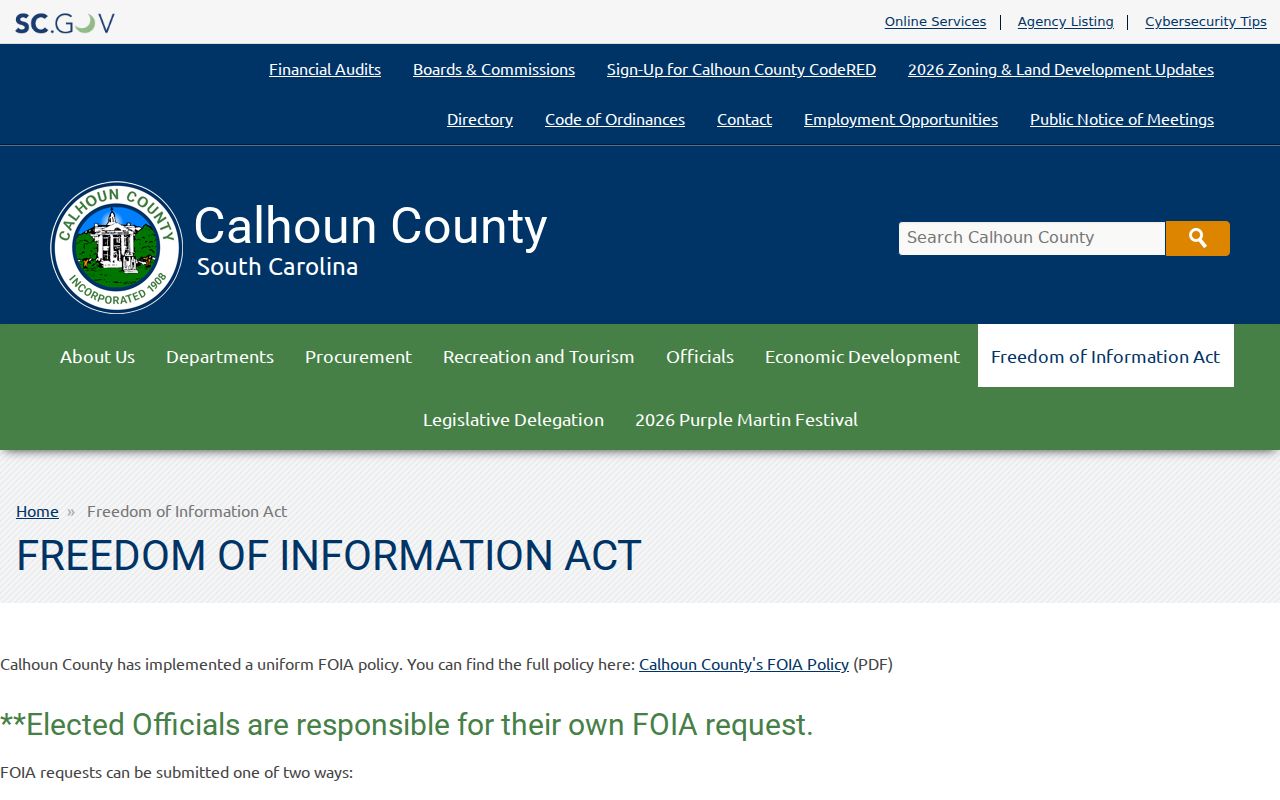
The county charges a $3 minimum, $0.25 per hard-copy page, and $20 per hour for staff search, retrieval, and redaction. Other media is billed at actual cost. If expected staff time exceeds five hours, the county may require one-quarter of the estimate as a deposit.
South Carolina FOIA identifies documents naming people confined during the prior three months as immediately available, except juvenile records. That rule gives Calhoun County readers a route when no public roster exists. It does not remove exemptions for active investigations, confidential sources, protected victims, medical information, or personal identifiers.
Inside a Calhoun County Arrest Record
An agency arrest report and a detention booking record overlap, but they are not the same. The agency report can include the report number, arrest date and time, location, officer or agency, legal basis, alleged offense, and a narrative subject to redaction. Booking adds intake identifiers, booking time, fingerprints, initial charges, bond and court information, custody status, and release data.
| Agency Report Number | Identifies the arresting agency's incident or arrest file |
|---|---|
| Booking Number | Identifies the regional detention intake record |
| Arrest / Booking Time | Separates the officer's custody event from later jail intake |
| Arresting Agency | Shows which office should receive a report-copy request |
| Initial Charges | Lists allegations entered at intake, which may later change |
| Bond and Court | Can show release terms and the court tied to the early case |
| Custody / Release | Shows current placement or release timing when publicly available |
| Booking Photograph | Release depends on the custodian, exemptions, and expungement status; no county online policy was found |
The filed court record then adds prosecution-selected charges, indictment, motions, hearings, disposition, and sentence. CATCH links reported fingerprint-supported cycles across South Carolina. To understand an event fully, compare the specific fields rather than treating the products as duplicates.
Calhoun Arrest Agency Channels
Agency identity changes the request path. The South Carolina Department of Public Safety handles Highway Patrol records through its official report and FOIA channels. SLED uses its own public-information process for state investigations. The South Carolina Department of Natural Resources handles its game and water enforcement records. Town matters must be verified through the relevant town or municipal court because no independent St. Matthews or Cameron police records portal was confirmed.
The image below is sourced from the official South Carolina Department of Public Safety site.
That channel is especially relevant for an interstate or state-highway arrest that the Calhoun County Sheriff did not make.
When requesting a report, include the incident number if known, date, time, location, people involved, record type, desired format, and any certification request. No sheriff-specific form, report fee, records email, fax, walk-in hours, or published turnaround was located. Calhoun County also has no official online warrant list. Call the Sheriff, check a public docket entry, contact the issuing summary court for a bench warrant, or seek releasable warrant information through FOIA. CATCH expressly excludes wanted-person information.
Booking Logs and Recent Arrests
Calhoun County does not offer an official daily booking log or blotter. For a very recent event, the shortest path is to call the regional detention center, then call the likely arresting agency. Search Calhoun Public Index after the charge is filed, and check the correct summary court as well. A focused FOIA request can seek an identifiable booking or confinement record when no online entry is available.
A roster, if the regional authority makes one available, would speak to current or recent custody rather than lifetime arrest history. People can be released, transferred, or never booked at that center. A report may also predate a court filing. CATCH is later and statewide, but SLED's repository depends on fingerprints and disposition reporting. Each time frame requires a different source.
Custody notifications are another distinct service. The following image is sourced from the official VINELink platform.
Verify that the actual holding authority participates before relying on notifications, since VINELink does not replace the regional detention center's direct status channel.
Calhoun Booking Fingerprints Reach SLED
South Carolina's central criminal history is fingerprint-driven. During booking, the facility records charges and takes fingerprints. Submission lets SLED connect the arrest cycle to the correct identity. The court or prosecutor later sends disposition information that should attach to the same cycle. Missing prints, changed charges, aliases, or incomplete disposition reporting can break that chain.
SLED reported in 2026 that only seven percent of 2025-to-date direct indictments had reached its redesigned repository, largely because subjects were not re-fingerprinted. That statewide finding matters in Calhoun County. A CATCH result can be useful for self-review, but a person seeking a high-confidence account should compare it with the Calhoun court file and the original arresting-agency record.
The following source image comes from the official South Carolina Law Enforcement Division site.
SLED is the statewide repository, not the Calhoun County jail custodian, and CATCH does not show wanted-person or sex-offender-registry data.
Calhoun Intake Through Bond
Regional booking begins after the arresting agency transports the person and supplies commitment or warrant paperwork. Staff search the person, inventory property, conduct health screening, take fingerprints and a booking photograph, enter intake charges, and make classification and unit-placement decisions. Initial or bond processing follows. The person may later be released or transferred.
Booking flow: Arrest › Transport › Intake › Fingerprints › Charges Entered › Bond Review › Release or Transfer
Operational rules for visits, telephone service, deposits, mail, and release were not confirmed on a stable official Calhoun source. Call 803-531-4658 for current instructions. Do not use a similarly named Calhoun County jail site from another state.
Note: A booking charge records the intake allegation; only the later court file shows the filed charge and final disposition.
Arrests Are Not Convictions
An arrest shows that an officer took a person into custody or began a formal arrest process based on an allegation. It is not a judgment of guilt. The initial charge can be amended, dismissed, nol prossed, no-billed, or end in acquittal. A conviction requires a guilty plea, verdict, or other legally valid judgment recorded by the court.
| Point | Arrest Record | Conviction Record |
|---|---|---|
| Created by | Arresting agency and detention facility | Court, with outcome reported to SLED |
| What it shows | An allegation, arrest, and possible booking | A court finding or accepted plea of guilt |
| Where to verify | Agency report and regional booking record | Calhoun clerk, correct summary court, and reported repository cycle |
| Possible ending | Release, transfer, or later charge decision | Sentence, appeal, or eligible expungement process |
The distinction also controls language. Public summaries should say a person was charged at arrest, not that the person committed or was convicted of the alleged offense. For the filed charge and result, use the Calhoun County criminal court cases record and read each disposition.
Note: An arrest is not proof of guilt, and a booking can end without a criminal conviction.
Calhoun Arrest Records After Expungement
South Carolina law can require destruction of eligible arrest and booking records after a valid expungement order. Under S.C. Code §17-1-40, the effect can reach associated warrants, booking photographs, and fingerprints, subject to statutory limits. Juvenile material and protected records have separate access rules.
Relief is never assumed from a dismissal label alone. General Sessions applications normally start with the First Judicial Circuit Solicitor. Qualifying summary-court dismissals, acquittals, or nol-prossed matters can follow the Magistrate or Municipal Court process. After an order reaches SLED, the agency advises allowing about four weeks before checking again. If an eligible item remains visible, SLED asks for a certified true copy, a recent CATCH report, and a self-addressed stamped envelope.
An expungement order changes access to eligible records. Verify completion with the issuing court, arresting agency, detention custodian, and SLED rather than relying on one database.