
Calhoun County Criminal Court Cases
Calhoun County Circuit Court is part of South Carolina's First Judicial Circuit. Its General Sessions division hears felonies and other criminal matters within Circuit Court jurisdiction. The Calhoun County Clerk of Court receives and dockets those files, receives criminal warrants, transmits warrants to the Solicitor, receives bonds, and manages the jury process. General Sessions is criminal; Common Pleas is the civil division. Those labels help readers avoid opening a civil search when they need a criminal court case.
Summary matters can remain outside General Sessions. Magistrate courts hear criminal offenses within the jurisdiction set by Title 22 and conduct preliminary functions. A municipal court can hear city ordinance matters and other criminal cases within its legal reach. The filing venue, not the place where a person first spoke with an officer, controls which clerk holds the case file.
Calhoun County Courts by Jurisdiction
Three summary-court locations in the official Calhoun County directory serve different parts of the county. The court contact at 2833 Old Belleville Road in St. Matthews is 803-874-1112. The Sandy Run contact is at 1724 Old State Road in Gaston, 803-794-4706. Another summary-court contact is at 1313 Bridge Street in St. Matthews, 803-823-2266. A reader should confirm venue before traveling because the county directory identifies judges and locations but does not turn every summary matter into a Circuit Court file.
The official South Carolina Magistrate Court guidance explains the statewide role of these courts. The image below comes from that Judicial Branch source.
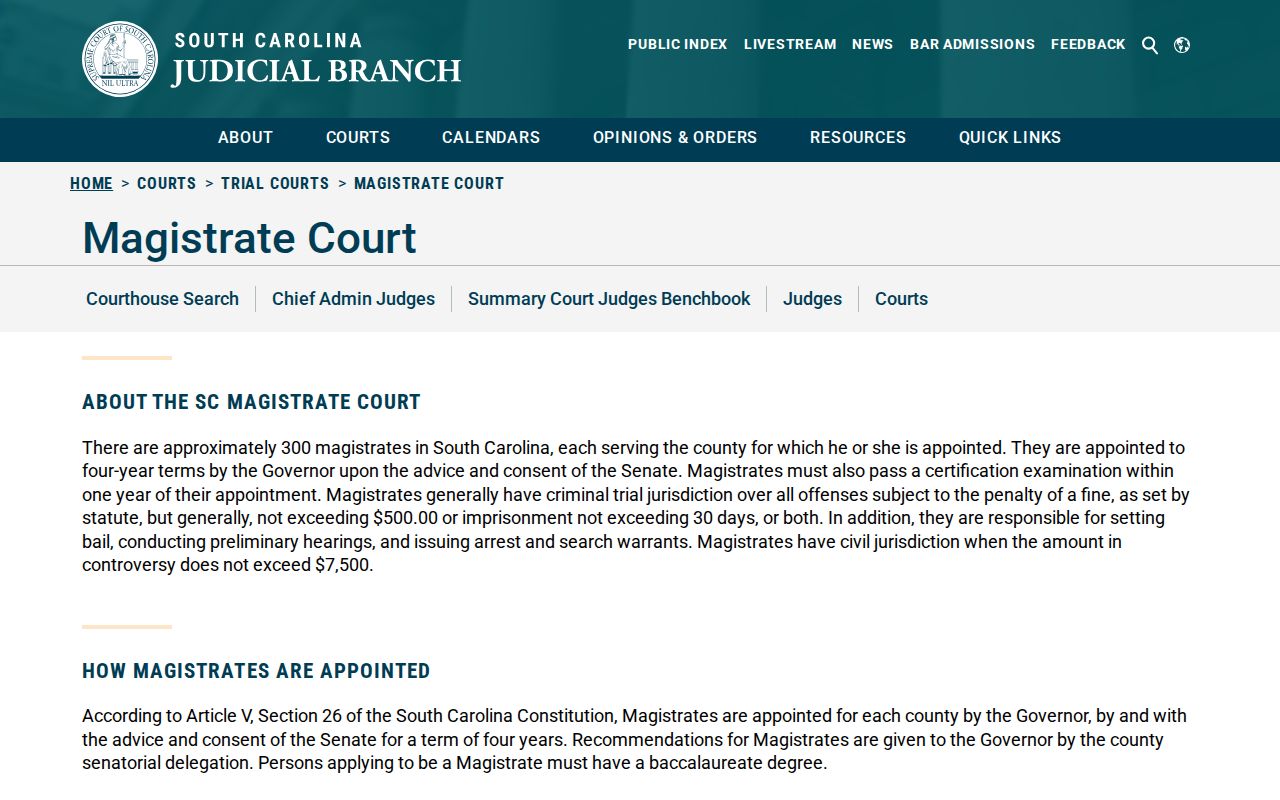
That statewide guidance provides the jurisdictional frame, while the Calhoun County directory supplies the local office and phone needed to locate a particular file. The Judicial Branch Municipal Court overview gives the parallel rules for city courts.
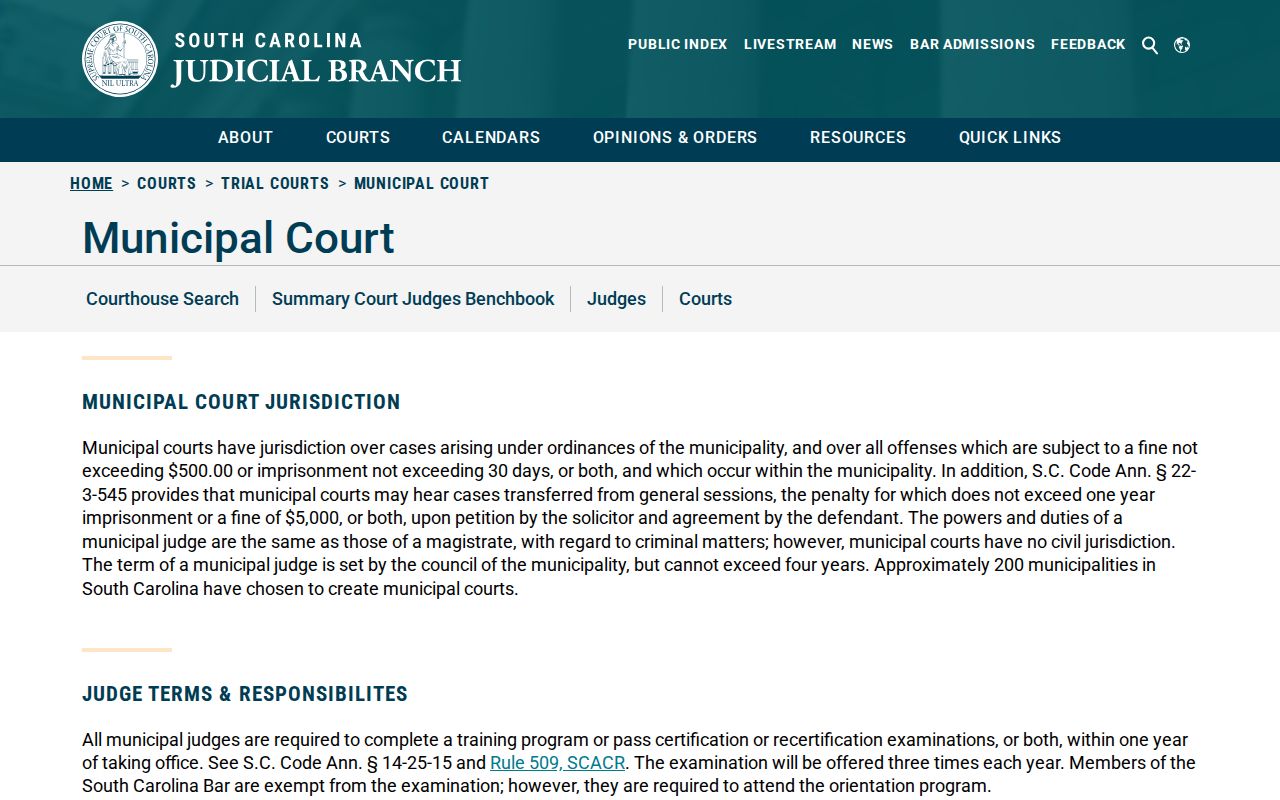
This distinction matters most when a name search returns no Calhoun County case: the record may sit in a municipal or Magistrate docket with only partial online participation.
Searching Calhoun County Case Records
Begin with the South Carolina Judicial Branch Case Records Search, choose Calhoun County, and open the county Public Index. Cookies and JavaScript must be enabled. Case detail can open in a pop-up, so a browser may need permission to display it. An exact case number is the strongest key. If it is unknown, use the last and first name, then narrow the results by date, court agency, case type, or status when those controls appear.
- Select Calhoun County through the Judicial Branch gateway and enter the county Public Index.
- Search the exact case number, or use surname and given name with careful spelling.
- Narrow by filing dates, court agency, case type, or case status where the live interface offers those fields.
- Open the detail window and note each charge, docket event, filing date, and charge-level disposition.
- Call the Clerk at 803-874-3524 for certified copies, archived files, or a case that should exist but does not appear.
| Field Label | Type | Required | Notes |
|---|---|---|---|
| Case Number | Text | Unspecified | Best identifier when the exact number is known |
| Last Name / Business | Text | Unspecified | Spelling controls the party-name match |
| First Name | Text | Unspecified | Narrows an individual party search |
| Middle Name | Text | No or unspecified | Useful for common names |
| Court Agency | Dropdown | No | Limits the court when exposed |
| Case Type / Status | Dropdown | No | Can narrow criminal and open or disposed matters |
| Date Filed From / To | Date | No | Restricts results to a filing period |
If the search fails, confirm the venue before drawing a conclusion. A summary matter may sit with a Magistrate or participating Municipal Court, while an archived General Sessions file may require a direct request to the Calhoun County Clerk.
Calhoun Public Index Case Search
The Calhoun County Public Index is free and informational. It can show docket events and outcomes, but it is not itself a certified record. Some municipal courts participate, not all. A missing city matter therefore calls for a direct check with the court rather than a claim that no case exists. Since January 1, 2026, home addresses no longer display on South Carolina's Public Index for new or existing cases.
The following image is sourced from the official Calhoun Public Index search interface.
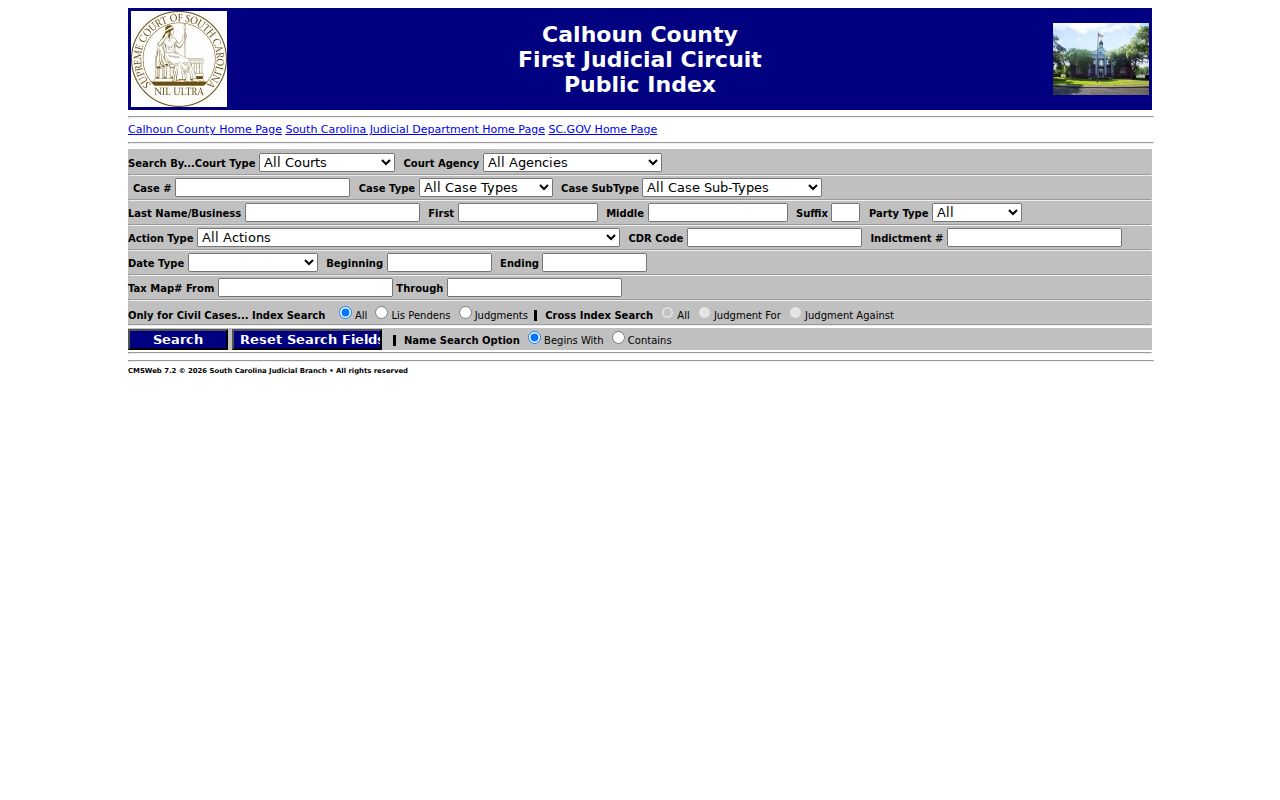
The screen confirms the county-specific starting point, but the clerk remains the source for certification, documents that are not downloadable, and older paper files.
Note: A blocked pop-up can hide the case detail even when the Calhoun County search result itself appears normally.
Inside a Calhoun County Case File
A Calhoun County criminal court file tracks the prosecution rather than merely repeating the booking record. Typical public fields include the case number, court agency, filing date, status, parties, attorneys, charge description, statute, offense date, arrest or warrant entries, indictment, bond, judge, hearings, docket events, disposition, sentence, and public financial entries. Availability differs by case, and an online field does not promise a downloadable source document.
| Case Number & Court | Identifies the file and the Calhoun County court agency that maintains it |
|---|---|
| Charging Document | May identify a warrant, complaint, or indictment and the filed statute |
| Docket Entries | Dates and descriptions of motions, filings, notices, and court events |
| Hearing Dates | Scheduled dates, times, locations, and later event entries where public |
| Disposition & Judgment | The charge-level outcome, such as conviction, dismissal, acquittal, or nol pros |
| Sentence & Conditions | Public punishment, costs, or supervision terms entered after conviction |
Private identifiers, protected victim or minor information, sealed and expunged material, and juvenile Family Court records are not ordinary public-index content. Home-address suppression is broader than sealing: it removes an address field from view without erasing the rest of an otherwise public case.
Reading Calhoun Case Dispositions
“Disposed” means that an ending event exists. It does not say which ending occurred. Open the charge detail and distinguish guilty or convicted from dismissed, acquitted, no bill, or nol pros. A nol pros entry means the prosecutor elected not to proceed. A remanded or transferred entry points to another court or process. A bench warrant is an enforcement event tied to a failure to appear or obey a court order and should be checked with the issuing court.
- General Sessions
- South Carolina Circuit Court's criminal division for felony and other matters within its jurisdiction.
- Indictment
- A grand jury's true bill formally charging an offense.
- Arraignment
- The court event where the filed charge is presented and a plea is entered.
- Nol pros
- Short for nolle prosequi, meaning the prosecutor elects not to continue that charge.
- Disposition
- The specific way a charge or case ended.
One Calhoun County case can carry several charges with different outcomes. The reader should never apply one charge's disposition to every count in the file.
How a Criminal Case Moves
A General Sessions matter can begin with investigation, arrest, or a warrant. Booking and fingerprints may follow, along with bond and early judicial review. The First Judicial Circuit Solicitor reviews the prosecution. A felony can proceed through a grand-jury indictment, arraignment, discovery and motions, then a negotiated plea or trial. Sentence follows a conviction, while appeal or post-conviction proceedings can create later entries.
Case flow: Charges Filed › Arraignment › Pretrial › Plea or Trial › Disposition › Sentencing
The Public Index event list may include routine administrative entries. Their presence proves only that the event was entered, not that a person was found guilty.
Calhoun Warrants Reach the Solicitor
The Calhoun County Clerk receives criminal warrants and transmits them to the First Judicial Circuit Solicitor. The Solicitor's Calhoun office is at 120 Mill Street in St. Matthews and can be reached at 803-874-1978. That role is distinct from the clerk's: the prosecutor reviews and pursues General Sessions charges, while the clerk maintains the filed docket and public court record.
A charge label can change between arrest and prosecution. The arresting agency records the alleged intake charge, but the court file reflects the charge the Solicitor actually files and its later outcome. For the arrest and booking side of that chain, the county's Calhoun County arrest lookup explains the separate sheriff and regional detention channels.
South Carolina is exact about summary-court reach. The official Magistrate criminal-jurisdiction statute is shown in the next source image.
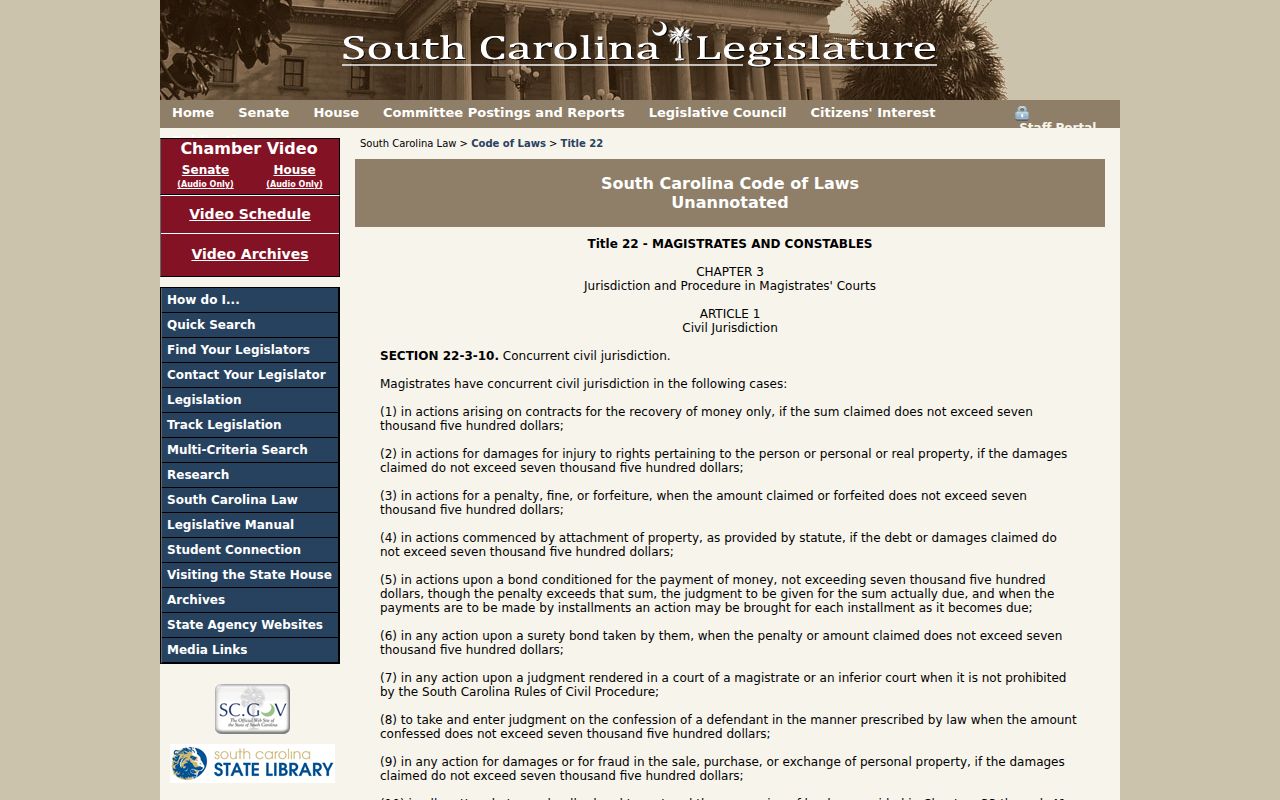
The statute helps explain why a lower-level file may remain at a Magistrate venue instead of entering General Sessions.
Case Record Access & Restrictions
South Carolina law begins from public access but preserves exemptions and court restrictions. Calhoun County court records can omit Social Security numbers, protected victim and minor data, financial identifiers, sealed or expunged material, and juvenile information. A Calhoun County General Sessions expungement request normally begins with the First Judicial Circuit Solicitor and can involve separate $250 Solicitor, $25 SLED, and $35 Clerk payments when applicable. Qualifying dismissed, acquitted, or nol-prossed summary charges can follow a no-cost Magistrate or Municipal Court route. Eligibility depends on the statute and disposition, not the docket label alone.
The South Carolina municipal-court statutes provide the legal framework for city court authority.
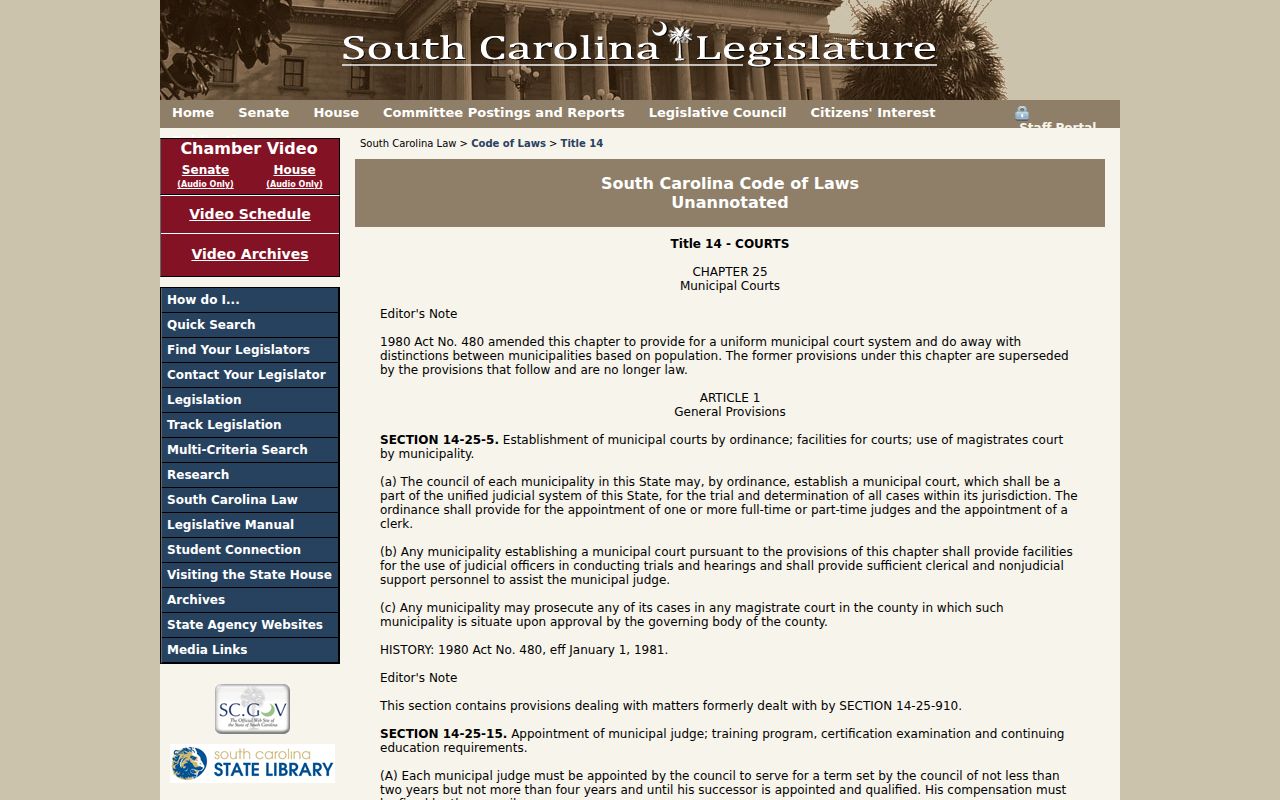
Those provisions support a separate municipal channel, so Calhoun County readers should check the proper city court when statewide search participation is incomplete.
Under the South Carolina Freedom of Information Act, public bodies may provide nonexempt, segregable portions while withholding protected content. Court copies should still go to the clerk that holds the file. A law-enforcement FOIA request cannot certify a court disposition.
Calhoun Court Copies and Certification
Clerk Robert Brockington's office is on the first floor of the Calhoun County Courthouse, 902 F.R. Huff Drive, St. Matthews, SC 29135. The counter is open Monday through Friday from 9:00 a.m. to 5:00 p.m., excluding major holidays. The published copy fee is $0.50 per page. The research did not locate a separate certification, archive-search, or case-search fee, so callers should ask before ordering.
Calhoun County Clerk of Court
902 F.R. Huff Drive
St. Matthews, SC 29135
803-874-3524
Monday-Friday, 9:00 a.m.-5:00 p.m.
Give the clerk the case number when possible. For a name search, provide the full name and a useful filing range. Ask whether the desired item is public, online, archived, available as a plain copy, or eligible for certification. The clerk's note that it does not perform criminal-record checks does not erase its role as custodian of General Sessions case files. A statewide history report is a different product.
Note: Calhoun County charges $0.50 per page, but no official source confirmed a separate certification or archive-search fee.